Author Archive

From the Desk of Dale Crossley and Evan Shear

From the Desk of Dale Crossley and Evan Shear
We hope this newsletter finds you and your loved ones well. Summer may be coming to an end, but the presidential race is heating up. With that in mind, you may expect that we would use this newsletter to address any anticipated election market impacts. As we’ve mentioned in other communications, election years tend to have a temporary impact on the markets, and our long-term financial plans are structured to manage the inevitable market ups and downs.
Instead, this quarter, we thought we would discuss a topic that’s becoming an increasing concern for our client base – longevity planning. According to the CDC, the average life expectancy in the United States is 77.5 years. As people live longer, planning for a fulfilling life in later years requires a more holistic approach to a prosperous and healthy future. Longevity planning goes beyond traditional retirement strategies, focusing on a balanced integration of financial security, physical health, and emotional well-being. By addressing these interconnected areas, individuals can create a roadmap that not only prepares them for the challenges of aging but also allows them to thrive in every aspect of their lives.
The Financial Side of Longevity Planning
There are a couple of important things to prioritize when you are considering how you will handle your financial life moving into your later years of life. In particular, you should think about the following:
- Preparing for Extended Retirement - It was once the case that one might expect to only have to plan for perhaps a few years of retirement. Now, with the potential for decades of retirement lying ahead, it is necessary to think about how you will have enough money to take to make it last. This calls for a dynamic investing strategy that will have you investing in selections that you might not have otherwise. In other words, you may consider putting money into investments that are likely to continue to generate returns for you long into the future.
- Anticipating Healthcare Costs - It is not necessarily fun to think about, but it is necessary to consider the healthcare costs that will likely sneak up on you at some point. Simply knowing that you are going to have healthcare expenses that you don't currently have to deal with is a step in the right direction. Prepare for a future where your healthcare expenses are going to go up and start investing for that future.
Health Insights From Blue Zones
Certain parts of the world are known as "blue zones." In these areas, the average lifespan of people who live within their boundaries is higher than for the planet as a whole.
This is exciting to know because it means we can intentionally try to create the conditions enjoyed by those in blue zones in our own lives to garner more enjoyment and appreciation. Using some of the practices of those in blue zones in your own life can potentially bring down your healthcare costs. A few things that people in these areas do well include:
- Eating a diet rich in fruits and vegetables
- Regular physical activity
- Maintaining strong social bonds
These three things can help you enjoy a healthier and potentially longer life while also reducing your retirement costs.
Integrating Financial and Health Planning
Far too many people fall under the false assumption that they must only focus on financial planning or health planning. The reality is that the two should feed into one another. When you are making wiser health choices, you ought to be able to appreciate the benefits of doing so by experiencing rewards in your financial life. Those rewards come in the form of reduced expenses.
Using blue zone practices is a great place to start. Consider adding them to your overall healthcare approach to create the best possible atmosphere for improving your health and generating long-term savings that you might not otherwise have had.
We Help With Longevity Planning
While our financial plans are developed for longevity and long-term financial success, we always encourage a plan review to ensure we’re aware of all your life changes and adjustments to future goals. If you would like to review your financial plan please reach out and schedule an appointment.
Any opinions are those of CrossleyShear Wealth Management and not necessarily those of Raymond James. The information has been obtained from sources considered to be reliable, but we do not guarantee that the foregoing material is accurate or complete. Links are being provided for information purposes only. Raymond James is not affiliated with and does not endorse, authorize or sponsor any of the listed websites or their respective sponsors. Raymond James is not responsible for the content of any website or the collection or use of information regarding any website's users and/or members.
There is no guarantee that these statements, opinions or forecasts provided herein will prove to be correct. All opinions are as of this date and are subject to change without notice. Past performance is not a guarantee of future results.
15-Minute Moist & Crispy Pan-fried Cod Recipe Doesn’t Need a Sauce
 15-Minute Moist & Crispy Pan-fried Cod Recipe Doesn't Need a Sauce
This easy pan-fried cod recipe is sprinkled with so many flavorful spices, it doesn't need a sauce.
Serve this easy fish recipe with your favorite side dishes. A side salad wouldn't be a bad idea, either.
Cuisine: American
Prep Time: 5 minutes
Cook Time: 10 minutes
Total Time: 15 minutes
Servings: 4 to 6
Ingredients
- 1 1/2 - 2 pounds cod fillets (or your favorite white fish) 1/2 cup flour
- 1 1/2 teaspoons paprika
- 1 1/2 teaspoons garlic powder
- 1 teaspoon onion powder
- 1/4 teaspoon cayenne (or more to taste)
- 1/2 teaspoon dried oregano
- 1/2 teaspoon dried thyme
- 3 tablespoons olive oil, for frying
- lemon wedges
Here's how to make it:
- Combine the paprika, garlic powder, onion powder, cayenne, oregano and thyme.
- Season the fish with salt and pepper. Sprinkle the seasoning blend on both sides of the fish.
- Put the flour into a shallow bowl. Dredge the seasoned fish in the flour.
- Heat the olive oil in a skillet. Add the fish and cook until crispy, browned and cooked through, about 4 to 5 minutes per side depending on thickness of the fish. (You may have to do this in two batches so you don't crowd the pan.)
Links are being provided for information purposes only. Raymond James is not affiliated with and does not endorse, authorize or sponsor any of the listed websites or their respective sponsors. Raymond James is not responsible for the content of any website or the collection or use of information regarding any website’s users and/or members. Raymond James does not provide tax or legal services. Please discuss these matters with the appropriate professional.
Retirement Planning: How to Know if You Are Saving Enough?

Retirement can appear like a dream if you base it entirely on the glossy pictures that you see put out by travel agencies and the like. Most of us can imagine a post-work life full of activities that we are truly excited to take part in. However, roughly 20% of Americans aged 50 or older have no retirement savings at all, and 61% are concerned about how they will afford retirement at all, according to an AARP survey. If you are concerned about your retirement savings or if you wonder how you can construct a plan that will work well for you, we want you to know that it is never too late to start, and we will help you figure out the process.
Starting Retirement Savings Early
There is an ironclad rule of retirement savings that you should know about, and it is that the earlier you start saving for retirement, the better. The sooner that you begin saving and investing for retirement, the longer your nest egg has to grow. Time is a hugely important factor when it comes to the total amount of retirement savings that you will ultimately enjoy. Compound interest in your investments will create a snowball effect on their growth and provide you with a larger nest egg when it is all said and done.
Estimating Your Retirement Needs
Every individual has specific needs regarding retirement. You can only figure out what your specific needs are once you have begun making some specific calculations. This is where our goal planning and monitoring (GPM) platform can come in handy.
This platform can help you nail down your specific retirement needs by running various savings variables and other factors that you might not have otherwise considered. This will help you figure out where you stand with things today and where you might need to pick up the slack.
Reviewing Your Current Retirement Savings
Another area where you can find great benefits from our GPM platform is in evaluating what your current savings picture looks like. You may think that you have some concept of how much money you have, but there is a decent chance that you aren't totaling up everything just perfectly. Remember, you must consider the following accounts when calculating your total savings:
- 401(k) savings
- Roth IRA savings
- Savings accounts
- Any other investment accounts designated for retirement
It is only when you put this entire picture together that you can start to see how it all works and where your actual savings total lands.
Maximize Employer-Sponsored Benefits
If you are not taking advantage of the employer-sponsored investment benefits offered at your job, then you are missing out. Many employers offer their employees the opportunity to invest in a variety of retirement plans. Not only that, but many employers offer matching funds (up to a certain contribution level) to help their employees gain even more from their investments. Make sure you capitalize on everything your employer has to offer in this respect.
Utilizing Catch-Up Contributions
As we mentioned at the top, there are many people who are near retirement who do not have the kind of retirement savings that they need. That said, there are catch-up contributions that can be made by those who are above a certain age to help them regain some of the ground that they have lost over time. If you feel like you are behind on your retirement savings, look at using catch-up contributions to help regain some ground.
Planning for Longevity
You don't want to outlive your retirement savings, and that means that you need to plan for longevity. Using our GPM platform, you can create a plan for yourself regarding how you will do this. You may want to consider certain options, such as:
- Delaying Retirement - You may need to wait a few extra years before you retire to ensure you have enough money to last for your entire retirement.
- Invest in Annuities - Annuities will pay you a certain amount of money each year that can help keep you afloat throughout retirement.
- Work Part-Time - It may be necessary to keep at least a part-time job while in retirement just to pay the bills. Consider doing this as well if you are planning on a long retirement.
Our GPM platform can help you figure out a strategy that is just right for you.
Regularly Review and Adjust Your Plan for Retirement Savings
Look at regularly reviewing and adjusting your plan as time goes on. Our GPM platform can keep you on the right path and guide you toward the answers that you need. For more information on how it all works and to get started today, please reach out and contact us now.
Opinions expressed in the attached article are those of the author/speaker and are not necessarily those of Raymond James. All opinions are as of this date and are subject to change without notice. Investing involves risk and you may incur a profit or loss regardless of strategy selected. Prior to making an investment decision, please consult with your financial advisor about your individual situation. Every investor’s situation is unique and you should consider your investment goals, risk tolerance and time horizon before making any investment. The forgoing is not a recommendation to buy or sell any individual security or any combination of securities.
Elections and Real Estate: What History Tells Us

Election years are a time of uncertainty. Whether you are a home buyer or seller, your attention may be drawn away from real estate during the few crucial months leading up to the election. This may also cause you some concern as to whether the real estate market itself will be impacted by the election. How do elections impact real estate?
While there is some small change in the housing market during an election year, the good news is that you likely have nothing to worry about. Election years, as a whole, do not cause the housing market to break from larger trends. Home prices typically remain on the rise, and the occasional dip is not perceptibly election-related in any previous election year.
You can gain confidence in this fact by looking at historical data.
Election Years Do Not Impact the Economy
Overall, presidential elections do not have a perceptible impact on the economy. US Bank reports that there is no direct link between an election year and stock market outcomes. Gale Academic research has uncovered that the theory of a slower economic year during an election is not only a myth but that any economic indicators have been historically stronger during election years.
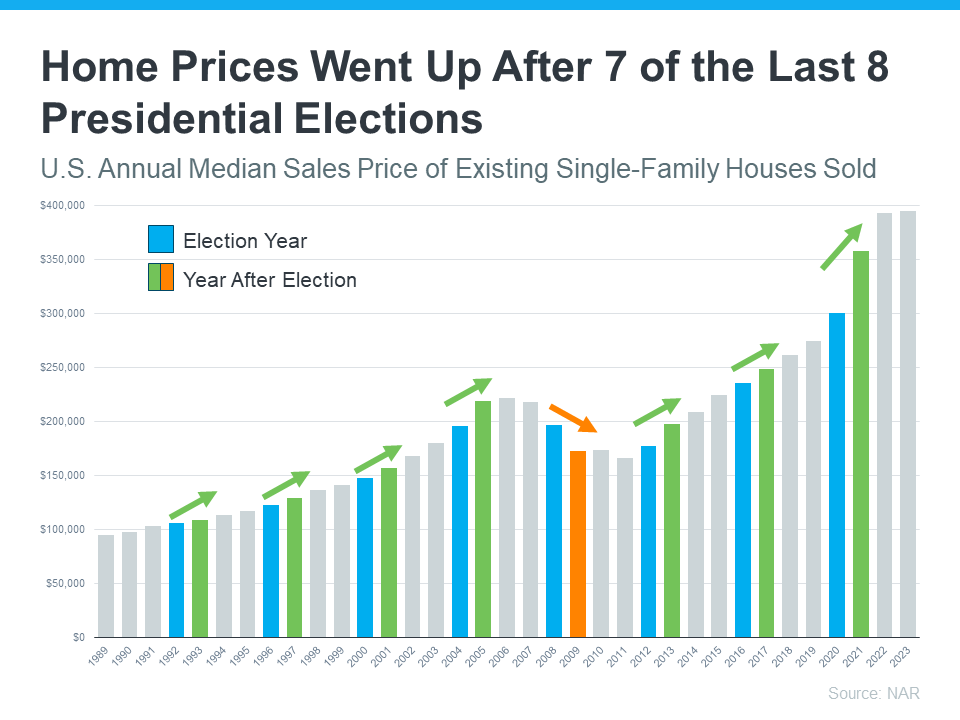
This is also true in the real estate industry. Data from the NAR shows that election years generally do not impact the home price trend perceptibly. Whether prices were following a multi-year trend of rising or falling, election years caused no significant change to the larger trend.
Home Price Trends
Real Estate Sales Remain Steady in Election Years
Just as home prices are unimpacted, so too is the rate of home sales. Home sellers can likely rest easy knowing that buyers are still making plans to buy in an election year. HUD NAR provides data that suggests election years maintain the home purchasing trend. However, home purchase rates may typically increase in the year after an election. This may be because the tension of the election is released. More people than usual feel confident making long-term decisions once they know who the president will be.
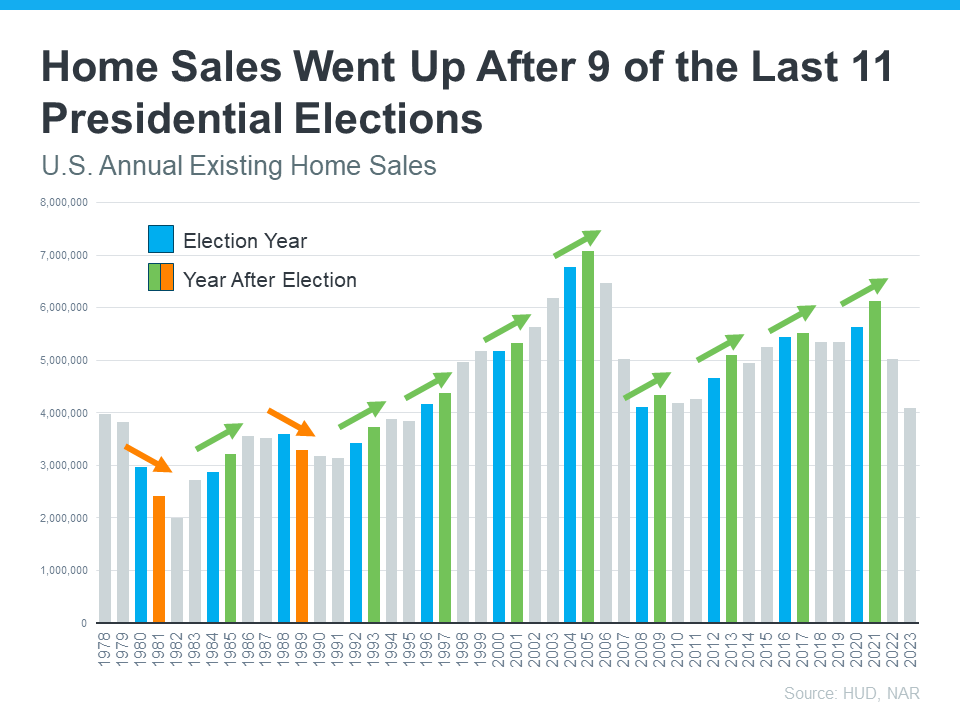
As you can see, the data shows that the number of home sales has gone up in the year after an election for the last 8 elections (since 1992) and has gone up for 9 of the last 11 elections since 1978.
The Dip: November Elections Impact on Real Estate
Historically a presidential election does have one small influence on the housing market: Home sales tend to slow down in November. Economist Ali Wolf reports that people may be cautious about making a big decision during the height of presidential election uncertainty. They will tend to put off on bidding or buying a house until they can be sure what to expect in terms of policy in the near future.
The good news is that the slowdown is not profound and doesn't last very long. Home sales typically pick back up to full speed by mid-December, and trends have resumed their normal course by April. Home sellers will see the full return of buyers, and buyers may see a new surge of available homes on the market as the election tension is resolved.
Mortgages Remain Unchanged
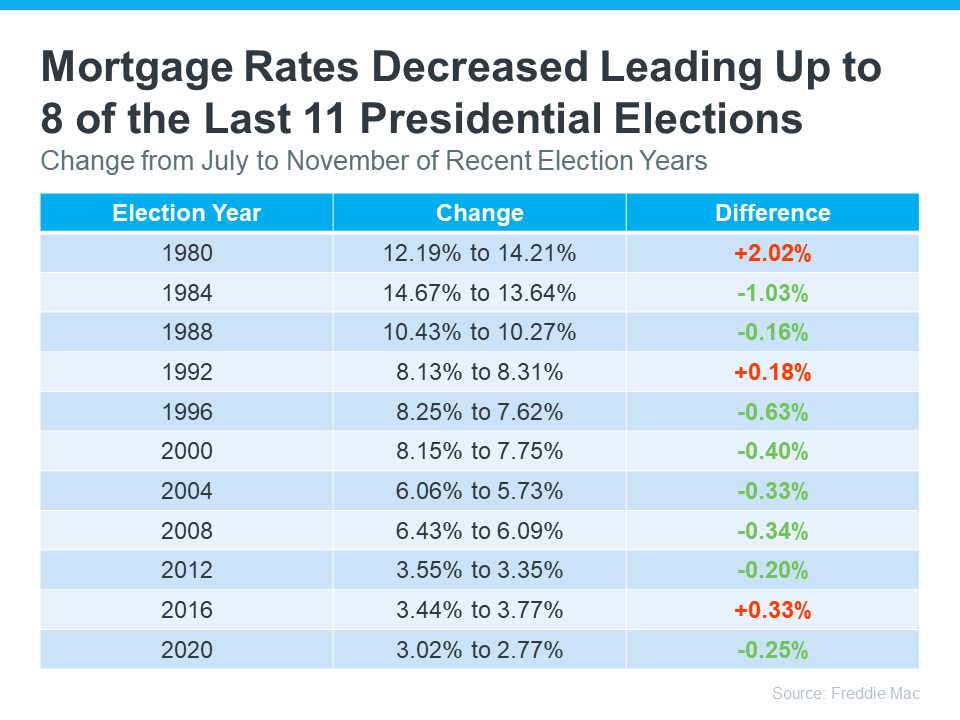
Mortgage rates also follow their own trends, and election years do not consistently impact mortgage rate increases or decreases. Freddie Mac reports that mortgage rates have decreased in the years leading up to 8 of the last 11 presidential elections, but these numbers follow existing trends as well.
2024-2025 Is a Safe Time to Buy or Sell a House
If you're looking to buy a home or are preparing a house to sell, don't worry about how elections impact real estate. Rest assured that the myth of the election year slow-down is just that: a myth. Both home prices and the rate of sales will likely remain steady, following existing trends. There may be a slight dip in activity in November, but not enough to cause a noticeable difference in the yearly totals.
Preparing to enter the housing market? CrossleyShear Wealth Management can help. Contact us today for your financial planning needs.
Any opinions are those of Dale Crossley and Evan Shear and not necessarily those of Raymond James. This information is intended to be educational and is not tailored to the investment needs of any specific investor. The information contained in this report does not purport to be a complete description of the securities, markets, or developments referred to in this material. The information has been obtained from sources considered to be reliable, but we do not guarantee that the foregoing material is accurate or complete, it is not a statement of all available data necessary for making an investment decision, and it does not constitute a recommendation. Investing involves risk and you may incur a profit or loss regardless of strategy selected. Past performance is not indicative of future results. Ð'dLinks are being provided for informational purposes only. Raymond James is not affiliated with and does not endorse, authorize, or sponsor any of the listed websites or their respective sponsors. Raymond James is not responsible for the content of any website or the collection or use of information regarding any website users and/or members.
Cyber Shield: Best Practices for Securing Your Personal Financial Data

In an era of innovative mobile software, convenient online banking, and endless cyber attacks your personal data is always at risk. Digital criminals continue to become more innovative in their methods to steal both individual and large archives of personal data to enact identity theft and financial fraud. The number of possible scams and hacking techniques only continues to grow.
Times are challenging for data security and financial safety. Now is a critical time to protect your personal data, and especially your financial information. The good news is that there are many security protocols and tools you can use to increase your personal data defense.
10 Ways to Protect Your Personal and Financial Data
1. Use Strong, Unique Passwords
Start by making your passwords longer, more complex, and more diverse. There are two methods for creating better passwords that are easy to remember.
Combination Words: eXtremely$afeP@ssw9rd
You can also use a password manager to keep all your passwords straight since it's best to use a unique password for every account and service.
2. Enable Two-Factor Authentication (2FA)
2FA or two-factor authentication sends you a text message or email to confirm logins. This is especially safe because most hackers don't have your phone or personal email. It also ensures you are notified if someone else tries to log in.
3. Be Wary of Phishing Scams
Phishing is when a hacker pretends to be someone familiar or a trusted brand in order to steal your information or get you to click an infected link. Phishing can target you personally or might set a general trap for people who use common brands. Always check if a sender or source is legitimate and trusted.
4. Monitor Your Accounts Regularly
Keep an eye on your financial accounts, especially your transaction history. Get to know your vendors and your own spending habits so that unknown charges are immediately obvious. Alert your financial provider to protect your account immediately if you notice suspicious activity.
5. Secure Your Devices
Keep your personal devices safe. Use lock screens, passcodes, and biometrics to ensure that all the personal data in your phone cannot be easily accessed if your phone is stolen. The same is true for any device where you are automatically logged into your apps and accounts.
6. Use Secure Networks
Hacked wifi networks are a common way for hackers to access personal computers and phones. Secure your home network with a firewall and router settings. Then, only use secured public networks when out in the world.
7. Be Cautious With Personal Data
Don't share your personal information in plain text. Even things that seem normal, like your name, address, and phone number, can be used to impersonate you and take over your accounts. Especially do not share any information about your finances, including the banks and services you use.
8. Educate Yourself and Stay Informed
Stay updated on the latest hacking and phishing tactics being used against companies and individuals. The cyber-threat landscape is constantly shifting as hackers develop new techniques to get around the latest defenses.
9. Implement Account Recovery Options
Account recovery options such as a connected phone number or backup account both make it more difficult for hackers to steal your accounts and make it easier for you to restore lost or stolen accounts.
10. Be Mindful of Data Breaches
Lastly, take data breaches seriously. Many apps and services will alert you if your passwords or accounts have been compromised. Take the necessary steps to re-secure your accounts, change your passwords, and protect your data or finances when these events occur. Most people experience some degree of data breach in their lifetime, often dozens of times in an adult career. Be wary and ready to respond.
Protect Your Personal Data and Your Financial Future
A single instance of identity theft can jeopardize your financial stability and future. Implementing practical cyber defense strategies is essential to protect your data, accounts, and finances. For comprehensive insights and personalized guidance on securing your financial future, trust CrossleyShear Wealth Management. Contact us for a consultation to ensure your financial well-being is safeguarded.