Author Archive

How does SECURE Act 2.0 change saving for retirement

How does SECURE Act 2.0 change saving for retirement?
Washington Policy Analyst Ed Mills outlines key components of the new legislation.
The year-end fiscal 2023 government funding bill contained legislation that makes the most significant changes to the U.S. retirement savings system in decades. The SECURE Act 2.0 legislation builds on retirement savings changes passed in 2019 and contains new provisions that further raise the required minimum distribution (RMD) age, shift to automatic plan enrollment and provide for new matching/emergency withdrawal opportunities. Most of the key provisions are effective in the 2024-2025 timeframe, but smaller adjustments (such as an increase in the RMD age to 73) will be effective in 2023. See below for a detailed overview of the key provisions in the legislation and the effective timelines.
SECURE Act 2.0 is the second bipartisan bill designed to boost access to retirement savings
The SECURE Act 2.0 is a follow-up bill to the original SECURE Act passed in 2019, which began the process of increasing the RMD age from 70 1/2 and increasing participation in retirement savings plans through various tax incentives and eased administrative rules for employer-sponsored retirement plans.
The new legislation goes well beyond the original iteration and seeks to expand participation in retirement savings plans through mandatory enrollments as well as increased flexibility in the individual use of advantaged savings accounts. The new legislation will also extend the savings timeframe before RMDs are required to 75 by 2033 – an almost five-year increase from the original RMD distribution age. Overall, the changes enacted by the legislation (to be phased in over a multi-year period) are likely to boost the asset base for asset managers through increased participation and interest in retirement savings plans.
Key changes will be phased in over a multi-year period
The most significant changes to the U.S. retirement savings system enacted as part of the recent legislation include a higher RMD age (rising to 75 by 2033), a shift to automatic enrollment for new retirement plans, an allowance for matching contributions to be made for student loan payments (expanding the retirement savings of younger adults), higher catch-up limits for those ages 60-63, and additional opportunities for penalty-free withdrawals/lower penalties for missed RMDs that are corrected.
Starting in 2025, eligible employees will be automatically enrolled into new employer-sponsored retirement plans. Contributions will be set with enrollment between 3-10%, rising by 1% each year unless employees elect to opt out. Under-the-radar provisions include an expansion of multiple employer plans (MEPs) and pooled employer plans (PEPs) to include 403(b)s, 529 to Roth IRA rollovers (max $35,000), and employer-offered de minimis financial incentives (such as gift cards or other financial awards) to increase employee participation in retirement plans.
Detailed descriptions of the key provisions as follows:
- Automatic enrollment: Eligible employees are required to be automatically enrolled in new 401(k) and 403(b) retirement savings plans with a contribution between 3-10%, rising by 1% annually (up to 15%) unless employees opt out. Automatic enrollment is effective starting 2025.
- Higher RMD age: The RMD age is raised to 73 in 2023 and 75 starting 2033.
- MEP and PEP access for 403(b) plans: Access to multiple employer plans (MEPs) and pooled employer plans (PEPs) is expanded to include 403(b) plans.
- Matching contributions for employee student loan payments: Plan sponsors may make matching contributions to 401(k), 403(b), and simple IRA plans for qualified student loan payments made by employees effective 2024.
- Expanded emergency expense distribution allowances: Emergency distributions of up to $1,000 are permitted for unforeseeable or immediate financial needs relating to personal or family emergency expenses once per year, to be paid back within three years (effective 2024).
- Tax and penalty free rollover from 529 to Roth IRA: Beneficiaries of 529 college savings accounts are permitted to rollover up to $35,000 from a 529 account in their name to a Roth IRA account. Rollovers are subject to IRA annual contribution limits and are available for 529 accounts which have been open for more than 15 years. Rollovers are permitted starting 2024.
- Reduced penalty for failure to take RMDs: A tax penalty of 50% for failure to take RMDs is reduced to 25%. For IRAs, the tax is further reduced to 10% if corrected. Reduction is effective as of the bill’s signing.
- Higher catch-up contribution allowances: For those ages 60-63, the catch-up contribution limit is raised to the greater of $10,000 or 50% higher than the regular catch-up amount. The higher allowance is effective starting 2025.
- Emergency withdrawals for domestic abuse survivors: Emergency withdrawals for the expenses of individuals escaping domestic abuse situations are provided at the lesser of $10,000 or 50% of the value of the account, to be repaid over three years with a refund of income taxes paid on the repaid amount. Withdrawals permitted starting 2024.
- Emergency withdrawals for disaster relief: Withdrawals of up to $22,000 from employer retirement accounts or IRAs are permitted for individuals affected by a federally declared disaster. These emergency-related withdrawals are permitted for disasters occurring on or after January 26, 2021.
- Expanded administrative cost tax credit for new businesses: A 50% tax credit for administrative costs incurred by new businesses is raised to 100% for companies with 50 or less employees effective 2023.
- Employer-offered incentives: De minimis financial incentives (such as gift cards or other financial awards) are permitted for sponsor efforts to boost employee participation in retirement savings plans, effective as of the signing of the bill into law.
Links are being provided for information purposes only. Raymond James is not affiliated with and does not endorse, authorize or sponsor any of the listed websites or their respective sponsors. Raymond James is not responsible for the content of any website or the collection or use of information regarding any website’s users and/or members. Raymond James does not provide tax or legal services. Please discuss these matters with the appropriate professional.
From the Desk of Dale Crossley and Evan Shear
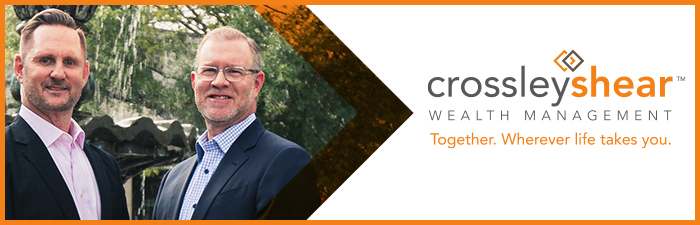
From the Desk of Dale Crossley and Evan Shear
"With a good perspective on history, we can have a better understanding of the past and present, and thus a clear vision of the future." — Carlos Slim Helu
It’s hard to believe we're beginning to reflect on 2022, but we just can’t help it. For investors, this year has been unforgettable and unfortunately, it’s just the kind of year we would all like to forget. We have witnessed the largest loss of investor capital ever experienced. Although it’s been an extremely rough ride, we were recently reminded how fortunate we are when Hurricane Ian ravaged our state. Our team members experienced some leaks, power losses, and had to deal with large amounts of debris. However, our experience is so minor compared to the catastrophe that others in our state are enduring. Our hearts go out to the victims of the storm who lost their property or experienced the tragic loss of a loved one.
We are truly grateful to have weathered the hurricane so well and try to keep the year-long market volatility in perspective as we know others are continuing to suffer. Back in June, we sent a communication letting you know that no one shares your frustrations about the markets more than us. In fact, over the last 25 years, we’ve never seen such volatility. The markets seem to change minute-by-minute each day, and virtually all sectors have been affected. Our team is constantly working to mitigate downside risk as much as possible, while still allowing our clients to reap rewards when it’s possible. Our Voyage process employs a disciplined approach, combining fundamental, tactical, and hedges to help guide our investment decisions. However, when pullbacks (defined as 15% or greater declines in the S&P 500) or crashes occur (defined as 20% or greater declines in the S&P 500), particularly when all sectors are affected, investors universally suffer.
The last three crashes were -57% in 2007-2009, -49% in 2000-2002, and -27% in 1980-1982 and the market proved resilient and recovered. For now, we can all look forward to an eventual recovery, the timing, however, remains to be seen. In the meantime, our team is working harder than ever to manage through this period. That’s why we’re here. If you have questions, or you would like to discuss your portfolio, please reach out.
Links are being provided for information purposes only. Raymond James is not affiliated with and does not endorse, authorize or sponsor any of the listed websites or their respective sponsors. Raymond James is not responsible for the content of any website or the collection or use of information regarding any website’s users and/or members. Raymond James does not provide tax or legal services. Please discuss these matters with the appropriate professional.
There is no guarantee that these statements, opinions or forecasts provided herein will prove to be correct. All opinions are as of this date and are subject to change without notice. Past performance is not a guarantee of future results.
“Ham and Cheese” Breakfast Casserole

"Ham and Cheese" Breakfast Casserole
Yield
Serves 6 to 8
Ingredients
4 cups (loosely packed) day-old challah or other egg-enriched bread (3/4-inch cubes) 2 tablespoons olive oil, divided
1 medium yellow onion, thinly sliced 3/4 teaspoon kosher salt, divided 1/4 teaspoon granulated sugar
8 ounces thickly sliced pancetta, diced 6 large eggs
1 1/2 cups whole milk
1/2 teaspoon dry mustard
1/4 teaspoon freshly grated nutmeg 2 teaspoons fresh thyme leaves
1/4 teaspoon freshly ground black pepper
1 cup grated Gruyère cheese (about 4 ounces)
Instructions
Grease an 8-inch square baking dish (or another 1 1/2-quart to 2-quart baking dish) and spread the cubed bread in the bottom.
Heat 1 tablespoon of the oil in a medium skillet over medium heat until shimmering. Add the onions, 1/4 teaspoon of the salt, and sugar. Cook, stirring occasionally, until lightly caramelized (a medium golden-brown color), about 15 minutes.
Meanwhile, in another heavy skillet, heat the remaining 1 tablespoon oil over medium heat and sauté the pancetta until the fat is almost all rendered and it
begins to get crisp, about 8 to 10 minutes. Transfer to a paper towel-lined plate to drain.
Whisk the eggs, milk, dry mustard, nutmeg, thyme, remaining 1/2 teaspoon salt, and pepper together in a large bowl.
Spread the pancetta over the bread cubes, then layer the onions on top. Sprinkle grated Gruyère on next, and then pour the egg mixture over the entire thing.
Press down on the top gently, so that all of the bread cubes get soaked a bit with the egg mixture. Cover and refrigerate overnight.
Arrange a rack in the middle of the oven and heat to 350°F. Take the casserole out of the refrigerator so it can warm on the counter while the oven preheats.
Bake, uncovered, until the edges are bubbling and the top begins to brown, 35 to 50 minutes. The baking time will be greatly dependent on the depth of dish you use. Check the interior with a knife; if it comes out clean the bread custard is baked through. (Cover with aluminum foil near the end of cooking if the top is already browned.)
Recipe notes
Make ahead: The casserole can be assembled, covered tightly with aluminum foil, and refrigerated overnight before baking. Uncover and bring to room temperature before baking.
Storage: Leftovers can be stored in an airtight container in the refrigerator for up to 4 days.
URL to article: https://www.thekitchn.com/recipe-make-ahead-ham-and-cheese-breakfast-casserole-43364
Links are being provided for information purposes only. Raymond James is not affiliated with and does not endorse, authorize or sponsor any of the listed websites or their respective sponsors. Raymond James is not responsible for the content of any website or the collection or use of information regarding any website’s users and/or members. Raymond James does not provide tax or legal services. Please discuss these matters with the appropriate professional.
Social Security increases benefits by 8.7% for 2023

Social Security increases benefits by 8.7% for 2023
This cost of living adjustment represents the largest increase in 40 years.
The Social Security Administration has announced a cost-of-living adjustment (COLA) to recipients’ monthly Social Security and Supplemental Security Income benefits. More than 65 million Americans will see the 8.7% increase in their payments beginning in January of 2023.
“We haven’t seen a cost-of-living adjustment like this since the early 1980s,” says Jim Kidney, Raymond James financial planning consultant. “It will provide welcome relief for Social Security recipients to help combat recent inflation.”
The increase – significantly higher than last year’s 5.9% COLA and the largest since the 11.2% adjustment in 1981 – is tied to the consumer price index for urban wage earners and clerical workers and was put in place to ensure the purchasing power of these benefits isn’t eroded by rising price levels over time
According to the Social Security Administration, on average, retired workers currently collect $1,681 per month in Social Security payments, or roughly $20,172 per year. The 8.7% COLA will add about $146 per month to those payments or $1,752 for the year.
Keep in mind all federal benefits must be direct deposited. So if you haven’t already started receiving benefits, you need to establish electronic transfers to your bank or financial institution. Contact your financial advisor for more information.
Source: Social Security Administration
The consumer price index for urban wage earners and clerical workers is a monthly measure of the average change over time in the prices paid by urban wage earners and clerical workers for a market basket of consumer goods and services.
Links are being provided for information purposes only. Raymond James is not affiliated with and does not endorse, authorize or sponsor any of the listed websites or their respective sponsors. Raymond James is not responsible for the content of any website or the collection or use of information regarding any website’s users and/or members. Raymond James does not provide tax or legal services. Please discuss these matters with the appropriate professional.
Make your final tax saving moves before Dec 31

Make your final tax saving moves before Dec 31
Proactive investors know that the months before year-end can be an ideal time to make strategic adjustments.
While keeping in mind your long-term investment goals, meet with your advisor and coordinate with your tax professional to examine nuances and changes that could impact your typical year-end planning.
Mind your RMDs
Be thoughtful about required minimum distributions (RMDs) to ensure that you comply with the rules – especially as some of those rules have shifted throughout the course of the pandemic.
Investors that reach a certain age – 70 1/2 for those born before July 1, 1949; 72 for those born after – are required to take RMDs from their IRAs. You’ll face a hefty 50% tax penalty on amounts not withdrawn from your IRA to meet the RMD, so be sure to speak with your advisor to ensure you’ve met your obligations.
A few reminders for future distribution planning:
- RMDs can be automated with your advisor to help ensure you don’t miss applicable deadlines.
- Your first RMD can be delayed until April 1 of the year after you turn 72. If you delay, however, you must also take your second RMD in the same tax year. This can inflate your income, which may affect your tax bracket.
- Subsequent RMDs must be taken no later than December 31 of each calendar year.
- Qualified charitable distributions allow traditional IRA owners who transfer RMDs to qualified charities to exclude the amount donated from their adjusted gross incomes, up to $100,000.
- Be mindful of how taking a distribution will impact your taxable income or tax bracket. If you have space left in your bracket or a down income year, you may want to consider taking additional distributions.
To harvest or not to harvest
Evaluate whether you could benefit from tax-loss harvesting – selling a losing investment to offset gains. The first $3,000 (single or married filing jointly) offsets ordinary income. Excess losses also can be carried forward to future years. With your advisor, examine the following subtleties when aiming to decrease your tax bill:
- Short-term gains are taxed at a higher marginal rate; aim to reduce those first.
- Don’t disrupt your long-term investment strategy when harvesting losses.
- Be aware of “wash sale” rules that affect new purchases before and after the sale of a security. If you sell a security at a loss but purchase another “substantially identical” security – within 30 days before or after the sale date – the IRS likely will consider that a wash sale and disallow the loss deduction. The IRS will look at all your accounts – 401(k), IRA, etc. – when determining if a wash sale occurred.
Manage your income and deductions
Those at or near the next tax bracket should pay close attention to anything that might bump them up and plan to reduce taxable income before the end of the year.
- Determine if it makes sense to accelerate deductions or defer income, potentially allowing you to minimize your current tax liability. Some companies may give you an opportunity to defer bonuses and so forth into a future year as well.
- Certain retirement plans also can help you defer taxes. Contributing to a traditional 401(k) allows you to pay income tax only when you withdraw money from the plan in the future, at which point your income and tax rate may be lower or you may have more deductions available to offset the income.*
- Evaluate your income sources – earned income, corporate bonds, municipal bonds, qualified dividends, etc. – to help reduce the overall tax impact.
Evaluate life changes
From welcoming a new family member to moving to a new state, any number of life changes may have impacted your circumstances over the past year. Bring your financial advisor up to speed on major life changes and ask how they could affect your year-end planning.
- Moving can significantly impact tax and estate planning, especially if you’ve relocated from a high income tax state to a low income tax state, from a state with a state income tax to one without (or vice versa), or if you’ve moved to a state with increased asset protection. Note that moving expenses themselves are no longer deductible for most taxpayers.
- Give thought to your family members’ life changes as well as your own – job changes, births, deaths, weddings and divorces, for example, can all necessitate changes – and consider updating your estate documents accordingly.
Next steps
Consider these to-do’s as you prepare to make the most of year-end financial moves, and discuss with your financial advisor and tax professional:
- Manage your income and deductions, paying close attention to your marginal tax bracket.
- Evaluate your investments, keeping in mind whether you could benefit from tax-loss harvesting.
- Make a list of the life changes you and your family have experienced during the year.
*Withdrawals prior to age 59 1/2 may also be subject to a 10% federal penalty tax. RMDs are generally subject to federal income tax and may be subject to state taxes. Consult your tax advisor to assess your situation. Raymond James does not provide tax or legal services. Please discuss these matters with the appropriate professional.
Links are being provided for information purposes only. Raymond James is not affiliated with and does not endorse, authorize or sponsor any of the listed websites or their respective sponsors. Raymond James is not responsible for the content of any website or the collection or use of information regarding any website’s users and/or members. Raymond James does not provide tax or legal services. Please discuss these matters with the appropriate professional.